
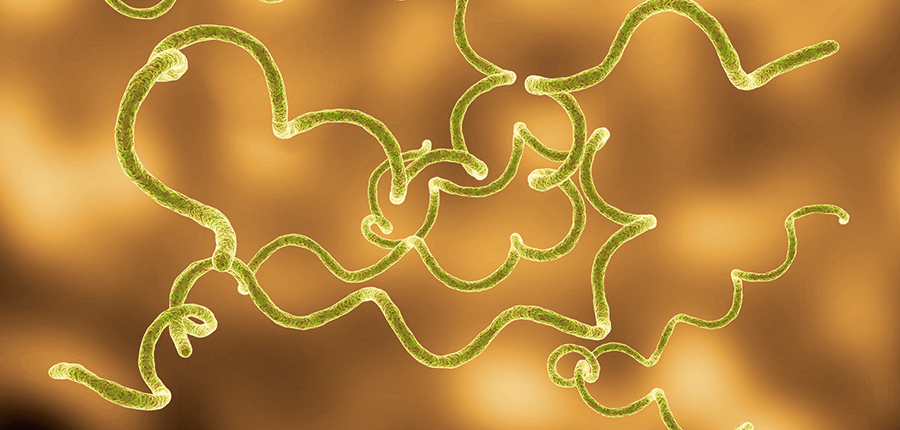
This 3D illustration depicts Borrelia burgdorferi, the spiral-shaped bacterium that causes Lyme disease. Image: Gilnature/Getty Images
In a pioneering leap forward in the fight against chronic Lyme disease, Michael Starnbach, PhD, a professor of microbiology in the Blavatnik Institute at Harvard Medical School, is making significant headway in understanding how Borrelia burgdorferi, the bacterium responsible for Lyme disease, evades the immune system. Using an innovative approach that draws parallels to cancer research, Starnbach and his team are exploring how the organism might mimic signals that instruct the immune system to suppress T cells, a strategy also employed by cancer cells.
This critical research has been fueled by generous support from Emily and Malcolm Fairbairn, MBA ’94. Their latest $300,000 gift has enabled the team to engineer tags on both B. burgdorferi and the T cells responding to it. “As a result, we can infect mice with B. burgdorferi and track the T cells as they respond,” Starnbach explains. This advancement allows the team to meticulously study the immune response dynamics, with the hopes of identifying therapeutic avenues that can enhance T cell activity and mitigate persistent infections.
Our ongoing commitment is fueled by the hope that these efforts will make a real difference for affected individuals.
Emily Fairbairn
The Fairbairns’ contributions have also accelerated investigations into using cancer drugs to potentially reverse the immune suppression seen in Lyme sufferers. Starnbach notes that his lab’s ultimate aim is “to define how T cells naturally respond to infection and develop therapies to allow better clearance of the organism without immune side effects.”
In addition to bolstering Starnbach’s work, the Fairbairns’ support has facilitated collaborations that have expanded the scope of the research. Notably, Tanja Petnicki-Ocwieja, PhD, a research assistant professor at Tufts University School of Medicine, is examining macrophage interactions with Lyme disease in Starnbach’s lab, while Novalia Pishesha, PhD, an HMS assistant professor of pediatrics based at Boston Children’s Hospital, is developing nanobodies to monitor real-time interactions between B. burgdorferi and the immune system in living models.
“We are thrilled to see Dr. Starnbach’s research drawing together such diverse expertise,” Emily Fairbairn says. Since 2018, she and her husband have given nearly $6 million to advance a range of promising research pathways at HMS aimed at better understanding Lyme disease and its devastating effects. This includes fostering a productive collaboration in the HMS Department of Immunology between professor Isaac Chiu, AB ’02, PhD ’09, and associate professor Jun Huh, PhD. The Chiu and Huh labs have achieved significant milestones in elucidating the pathogenesis of Lyme disease, with Chiu concentrating on chronic pain and nerve damage linked to B. burgdorferi infection, and Huh focusing on the neurological symptoms and mechanisms of infection that result in motor deficits and anxiety-like behaviors.
“Our ongoing commitment is fueled by the hope that these efforts will make a real difference for affected individuals,” Emily Fairbairn says.

Although most Lyme disease patients fully recover after treatment, some experience prolonged symptoms that can lead to considerable suffering, according to the Centers for Disease Control and Prevention. |
|---|