

Image: Gretchen Ertl
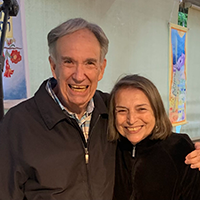
For David N. Levine, MD ’68, Harvard Medical School is woven into the fabric of his life. He spent 28 years within the HMS community—first as a student, then as a resident and faculty member—and credits the School with shaping both his scientific approach and his career as a neurologist.
“I was inspired by my teachers, who taught me how to think scientifically: to observe, gather information, and form hypotheses,” Levine says. “They helped me become both a clinical and basic researcher.”
During medical school, Levine took a year off between his second and third years to conduct research. This experience deepened his appreciation for the value of dedicated time to pursue scientific questions. His connection to HMS continued through his neurology residency at Massachusetts General Hospital (MGH) and his years as a member of the MGH faculty. He remained at MGH until moving to New York City in 1991.
Now he and his wife, Roslyn, have established a $1 million charitable gift annuity (CGA) to support HMS students undertaking a fifth year of research focused on basic science. “I admire Harvard as a place dedicated to advancing knowledge, both in basic biology and in its application to clinical medicine,” Levine says.
For Levine, a fifth year allows students interested in research, but not ready to commit to the many years required for a PhD, to deepen their knowledge in a particular area. It may also help them decide whether and to what extent medical research will be a part of their future careers.
Altaf Saadi, MD ’13, an HMS associate professor of neurology at MGH and director of the HMS Office of Scholarly Engagement, which coordinates required and optional research projects for MD students at HMS, says fifth-year research experiences give students dedicated time to develop deep scientific and analytical skills without the demands of clinical rotations.
“This protected time allows them to grow as scientists and contribute meaningfully to a scientific mission,” she says. “They build a stronger residency application and position themselves to make a greater impact on their chosen field.”
Financial support enables more students to pursue projects and ideas that might otherwise be prohibitive, Saadi says. “It allows innovative science to be at the forefront for students pursuing a fifth year, and not just for those who can afford it.”
The future proceeds from the Levines’ CGA will create an endowed fund named in memory of their late son, Charles M. Levine, who died at age 34 while completing his residency. Charles had received his MD and PhD degrees from New York University.
“He was a great gift to us for the 34 years he lived,” Levine says. “We wanted to perpetuate his memory.”

A charitable gift annuity allows a donor to make a gift to HMS now, receive fixed annual income payments for life, and ultimately support the area of their choosing at HMS. “It gives you income and added security during uncertain times,” David Levine says. “And, in the end, you’re supporting a worthwhile cause.” |
|---|