
By Randy Fox
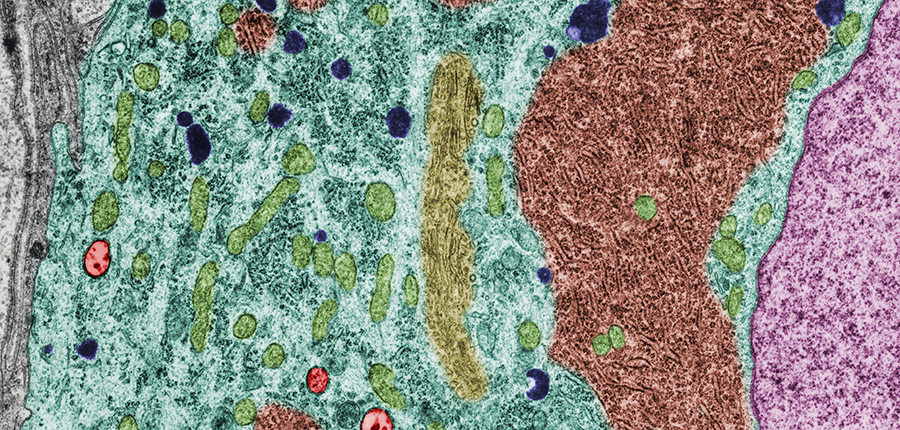
This false-color transmission electron microscopy image shows a neuron cell body, with lysosomes highlighted in dark blue along with other intracellular structures. Image: Jose Luis Calvo Martin and Jose Enrique Garcia-Mauriño Muzquiz/Getty Images
A global research team led by Wade Harper, PhD, the Bert and Natalie Vallee Professor of Molecular Pathology and chair of the Department of Cell Biology in the Blavatnik Institute at Harvard Medical School, has received funding from The Michael J. Fox Foundation for Parkinson’s Research (MJFF) to investigate endolysosomal targets linked to Parkinson’s disease. The team’s mission is to understand—and ultimately repair—a crucial cellular recycling system that goes awry in Parkinson’s disease (PD).
The grant was awarded through MJFF’s Targets to Therapies Initiative, which aims to increase confidence in promising biological targets and help de-risk their advancement toward therapeutic development.
Harper and his colleagues are focusing on lysosomes, tiny compartments inside cells that act as recycling centers. Lysosomes break down worn-out parts and dispose of unwanted or potentially toxic proteins, including forms of alpha-synuclein that can accumulate in PD. When lysosomes fail to function properly, cellular waste builds up, vital structures like mitochondria are damaged, and neurons become increasingly fragile.
Growing genetic evidence links the broader endolysosomal system—the network of lysosomes and related compartments responsible for cellular recycling—to Parkinson’s disease risk. The team will examine three lysosomal membrane proteins strongly linked to the disease: ATP13A2, TRPML1, and TMEM175. These proteins are key conduits for the movement of ions and small molecules in and out of lysosomes, helping maintain the correct acidity and electrolyte balance inside.
New tool reveals hidden mutations in Parkinson’s disease
In a subset of people with Parkinson’s, these proteins are altered or don’t work properly. Using human neurons grown from stem cells, the consortium will investigate what happens inside cells when each of these molecular gatekeepers fail. The team will measure how effectively lysosomes break down waste, how they communicate with other cellular structures, how they respond to damage, and how changes in lysosomal function affect neuronal firing patterns.
“Collectively, we expect to deliver new assays and datasets that reveal higher resolution and quantitatively precise elements of endolysosomal function and PD-relevant defects,” says Harper. “Our efforts also have the potential to identify new biomarkers and convergent pathological pathways.”
A major goal is to test whether small-molecule drugs that boost lysosomal activity can correct these defects. The team will test promising compounds in neuron models carrying a range of PD risk genes to determine whether the drugs can restore healthy lysosomal function and protect vulnerable cells. If some of these molecules either improve lysosomal health or normalize neuronal firing, they could point the way to new treatment strategies and early markers of disease.
The project is profoundly collaborative. Alongside Harper, co–principal investigators from KU Leuven, Ohio State University, Stanford University, the University of California, San Diego, and the University of Oxford bring complementary strengths—from advanced lipid and protein analysis to high-resolution imaging and expert electrophysiology. By sharing cell models, experimental tools, and data across labs and continents, the consortium aims to build a robust, shared platform that the entire Parkinson’s research community can use to evaluate future drug candidates.
“Through the Targets to Therapies Initiative, we’re addressing critical evidence gaps to advance promising Parkinson’s disease targets that have the potential to become strong drug candidates,” says MJFF Senior Vice President and Head of Translational Research Shalini Padmanabhan, PhD. “The endolysosomal system has emerged as an important area of Parkinson’s biology, and the shared tools and data generated through this work will help build robust data packages to inform both current and future therapeutic strategies.”
Related Story
Spring 2025
Aligning Science Across Parkinson’s grant of $5.25 million fuels bold research.