
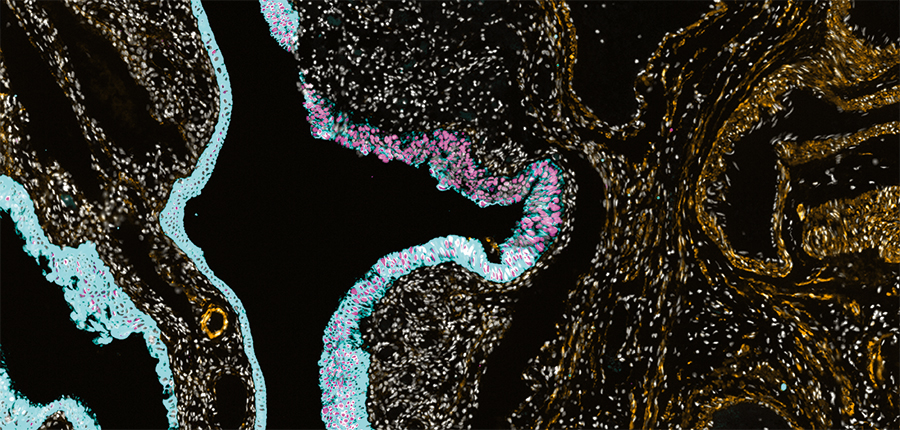
This microscopic view shows the molecular features of an early ovarian precancer (highlighted in aqua and pink). Image: Santagata lab
In their quest to transform cancer care, two researchers in the Harvard Medical School Laboratory of Systems Pharmacology (LSP) are leading a pair of projects that offer hope to individuals with BRCA1 and BRCA2 gene mutations. These mutations significantly increase the risk of developing breast and ovarian cancers at a young age, prompting some carriers to consider invasive procedures, such as prophylactic mastectomy or oophorectomy (removal of ovaries), even before a cancer diagnosis.
“Developing new diagnostics to assist with challenging decisions about preventive surgery or treatment of early cancers can profoundly affect quality of life,” says Peter Sorger, AB ’84, PhD, the Otto Krayer Professor of Systems Pharmacology in the Blavatnik Institute at HMS.
He and Sandro Santagata, MD, PhD, an associate professor of systems biology at HMS and an associate professor of pathology at Brigham and Women’s Hospital, seek to shift cancer care toward proactive, less invasive strategies.
Building a portal for data-driven, tailored cancer treatments
A central element of their work is the Gray BRCA Pre-Cancer Atlas, a pioneering digital resource for data on early-stage breast and ovarian cancers. (The “Gray” denotes the Gray Foundation, which supports the research of leading physicians and scientists who are focused on the prevention, interception, and early detection of BRCA-related cancers.) Sorger notes that remarkably little information is available about cancers at early, potentially curable stages, emphasizing, “This portal is particularly important because much of the data we are collecting and releasing does not yet have an organized home in an NIH-supported repository.”
These projects align with our mission to address BRCA-related cancer challenges through innovative research, moving us closer to our ambition to stop these cancers before they start.
Dana Zucker

The Gray Foundation has contributed nearly $200 million to leading research institutions for the treatment and prevention of BRCA-related cancers. |
|---|